These two go together because they are the literal bottlenecks right now. You cannot scale AI without advanced chips, interconnects/optics, memory, packaging, cooling, data center capacity, and reliable power. Hyperscalers are guiding sustained massive capex and repeatedly citing power/grid delays as top risks.
Why first: Money flows to the constraints hardest and earliest. This is where the biggest near-term multiples have come from and where I expect the strongest risk/reward to remain for the next several quarters while supply is still catching up.
When I know it’s their time (and when to start rotating out):
Strong hyperscaler capex guidance and commentary on power shortages.
Continued outperformance vs the broader market on AI infrastructure news.
Rotate signal: Momentum slows, valuations get extremely stretched on low-conviction names, or we start seeing clear evidence that supply is catching up faster than expected and AI Beneficiaries begin showing big earnings acceleration (and investors finally realize this). I’ll trim winners here to fund the next buckets rather than go all-in on one theme forever ofc.
The other main signal will be charting themes: seeing the AI-Enablers/AI-Beneficiaries and seeing which have outperformed and where support will land.
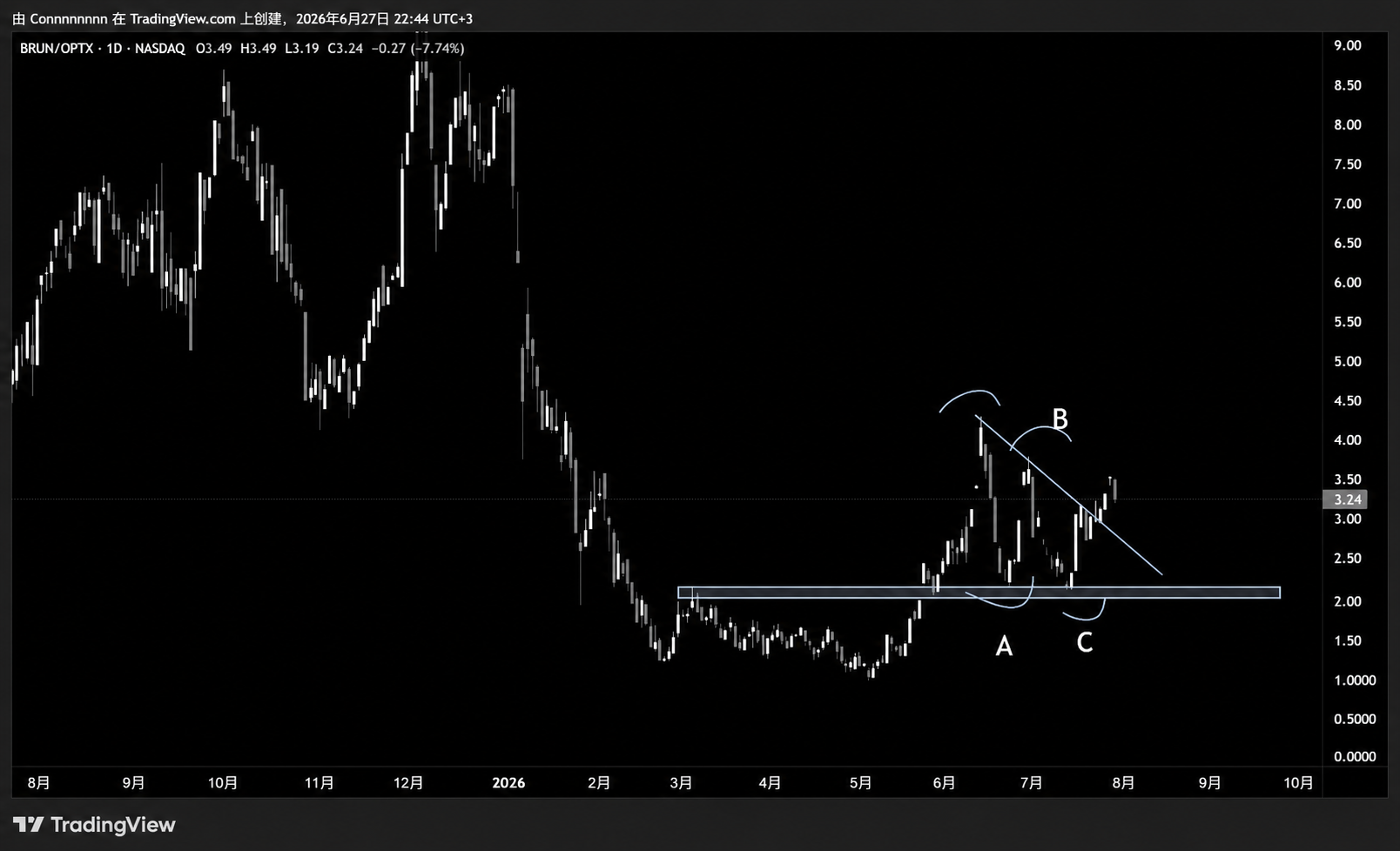
An example of this is here:
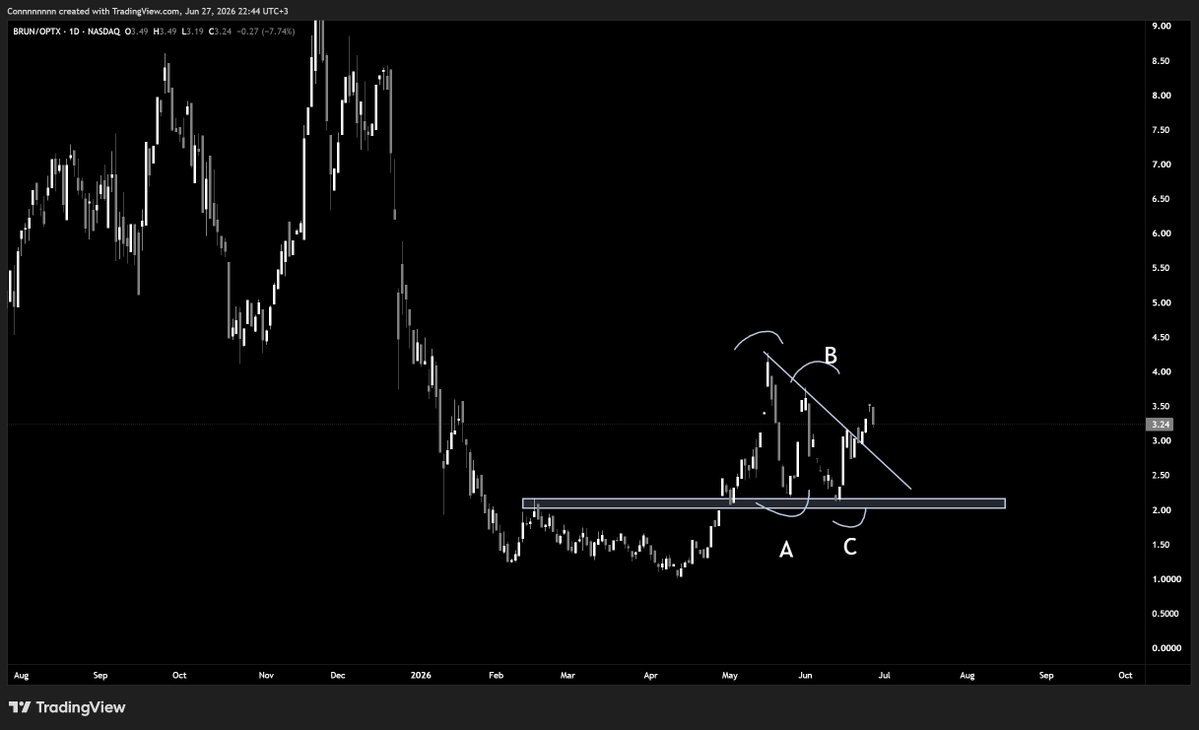
BRUN/OPTX (not an enabler/beneficiary, but just an example): using classic TA, it looked like BRUN would outperform after hitting that support level, and guess what, it did…
Figure 1: The author’s technical-analysis example using support, a descending trend line, and an A/B/C structure.
Once the infrastructure is built and power/compute becomes more available and affordable, the software and application layer can finally prove ROI at scale. This is where earnings growth (not just revenue hopes, as what’s happening rn) becomes the driver.
Space slots in here because it is domain expansion happening in parallel. It extends AI and connectivity into new frontiers (global coverage via satellite broadband, Earth observation data for better models, autonomous space systems, future orbital compute concepts). It has its own strong catalysts (launch cadence, constellation buildout, government contracts) that don’t fully depend on terrestrial data center ROI being proven first.
Why together in this phase: Beneficiaries need the foundation to work. Space benefits from the same tech stack (advanced electronics, optics, power) but adds massive new TAM and independent government/commercial tailwinds. Both become more credible once the Enablers/Power phase has de-risked the broader AI story imo.
When I know it’s their time (and when to rotate):
AI Beneficiaries: Clear earnings beats driven by AI features + improving margins or guidance. Fear narrative starts to fade, and this is when investors will realize that AI beneficiaries won’t be vibe coded lol.
Space: Visible execution (successful launches, constellation milestones, backlog conversion, commercial service announcements). Rotate signal: Beneficiaries show sustained growth but relative strength fades as the market looks for the next physical deployment theme. Space moves from heavy buildout phase into profitability focus.
Ofc, I will continue to chart the stocks such as AI-enablers/AI-beneficiaries/space/robotics, etc.
This is where AI moves from screens and data centers into the physical world at scale: robots, automation, in-space assembly, lunar/Mars infrastructure, etc. It requires cheap/reliable compute + power + advanced hardware (sensors, actuators, comms) that only become viable after the earlier phases.
Space winners (after the heavy infrastructure buildout) shift focus to profitable operators and data/services businesses.
Why here: Embodied intelligence and space operations are the logical next deployment layer once the digital foundation and early monetization are working. This is the 2027+ part of the cycle for a reason.
When I know it’s their time:
Robotics: Real deployment traction, cost curves bending, pilot programs scaling to production.
Space: Shift from “will they launch successfully?” to “which operators are actually making money and winning contracts long-term?” Rotate signal: These themes start showing consistent revenue and path to profitability while the market begins rotating toward the next foundational upgrade (Quantum).
Quantum is the potential successor or powerful accelerator to classical silicon for specific hard problems (simulation, optimization, certain ML tasks). It needs its own infrastructure advances (error correction at scale, hybrid software stacks, cryogenics/control systems) and only becomes a major capital allocation theme once the current silicon wave has matured or hit clear limits.
Why last in the main sequence: It is the longest-term foundational upgrade. Early positioning makes sense for asymmetry, but the big rotation into it happens after we’ve seen what the current AI buildout can actually deliver.
When I know it’s their time: Technical milestones (logical qubits, error rates, hybrid AI-quantum commercial wins) start translating into meaningful revenue or major partnerships. Government funding and big-tech integration accelerate. And perhaps, finally non-government funding, meaning businesses will actually start paying for quantum from real businesses.
Ofc, charting majors/majors, this is for every rotation.
Crypto sits outside the pure tech stack rotation. It is more sentiment-, liquidity-, and cycle-driven (Bitcoin halving effects, regulation, risk-on environments). It can have violent moves at any time but tends to perform best when macro conditions are favorable and narratives around decentralized compute or AI infrastructure strengthen.
Why as an overlay: It doesn’t need the AI infrastructure sequence to play out, but it can amplify returns in risk-on phases or serve as a hedge/alpha source when traditional tech rotates.
I personally think this niche has bottomed. It is just early/smart money buying in now; the major run will be later.
Core approach: Start with heavy weighting in the current binding constraint phase (Enablers + Power). Use outperformance and stretched valuations as signals to trim and redeploy into the next phase rather than selling everything at once.
Position sizing: Larger allocations to earlier phases while they are working. Smaller “satellite” positions in later phases (Robotics, Quantum, Crypto) that I can size up on clear catalysts.
Rotation triggers (practical checklist): Clear catalysts + relative strength improving + reasonable risk/reward vs the current leaders.
Out / Trim: Momentum divergence, valuation extremes on low-conviction names, or the next phase showing accelerating news flow and capital inflows.
This framework lets me stay aggressive where the constraints and catalysts are strongest today, while systematically building exposure to the themes that logically come next.
Now, remember, the goal isn’t to perfectly time every top and bottom. Although we should be close. It’s to be positioned in the right buckets when their respective catalysts hit, compound across multiple waves, and avoid being overexposed to a theme after its best days are behind it.
There’s my full rotation thesis, and how I’m planning on playing all of 2026-2027.
I hope you enjoy (and perhaps follow me along) if you want to know exactly when these rotations occur.